As a digital marketer, you’re likely familiar with the importance of tracking key metrics to measure the success of your campaigns. While metrics like conversion rates and cost per conversion are crucial, they only provide a partial picture of a campaign’s financial performance. To truly understand the effectiveness of your marketing efforts, you need to consider return on ad spend (ROAS). ROAS is a vital metric that helps you determine whether your campaigns are generating revenue and helping you achieve your business goals.
So, what is ROAS, and how do you calculate it? In this article, we’ll dive into the world of ROAS and explore its significance in marketing. We’ll also cover the steps to calculate ROAS, discuss what constitutes a good ROAS, and provide you with tips on how to optimize your campaigns for better financial performance.
Understanding ROAS
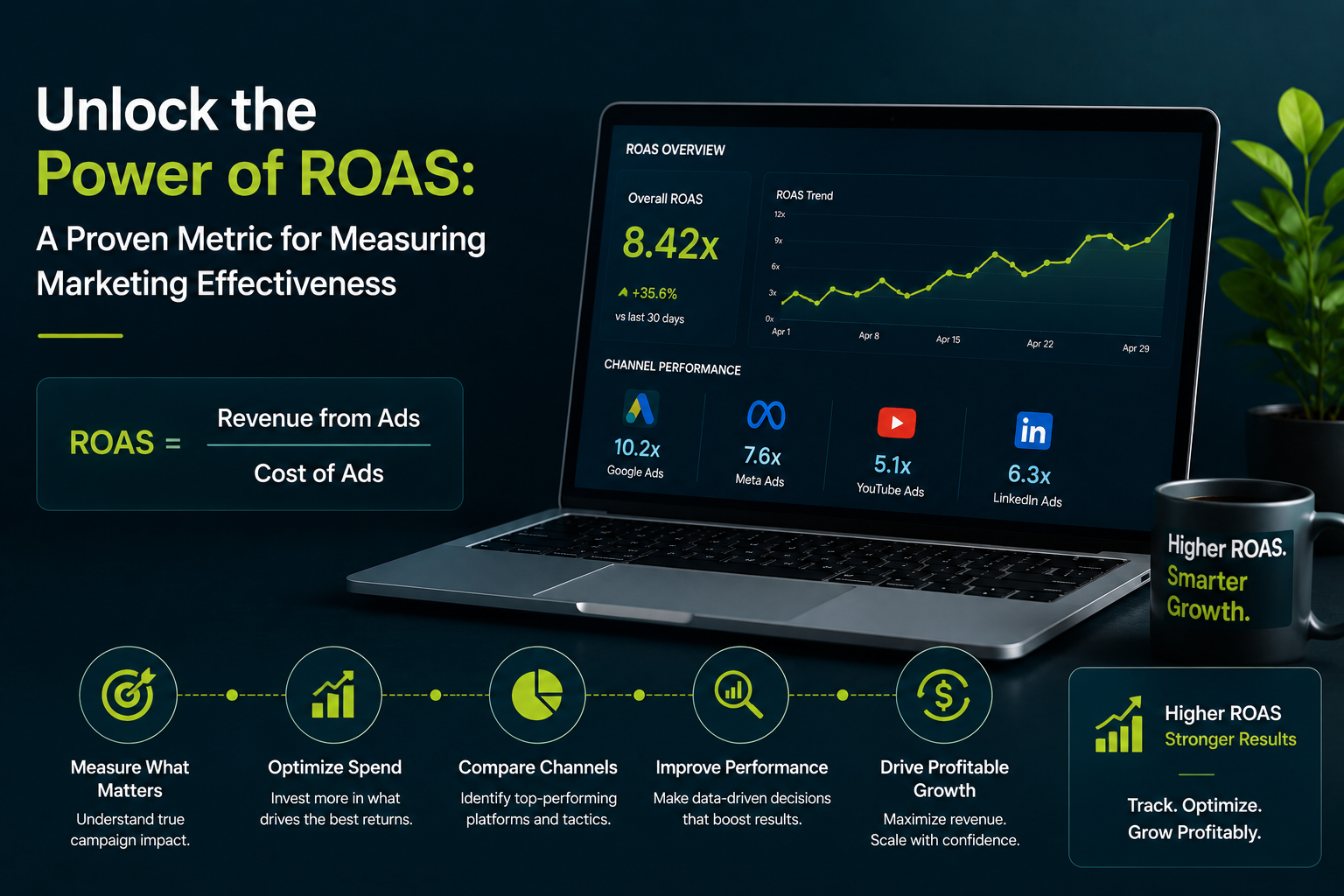
ROAS is a metric that measures the revenue generated by your ad spend. It’s a simple yet powerful metric that helps you understand the financial impact of your marketing efforts. ROAS is calculated by dividing the revenue generated by your campaign by the cost of the ad spend. For example, if your campaign generates $10,000 in revenue and costs $2,000 to run, your ROAS would be 5:1, meaning you’re generating $5 in revenue for every $1 spent.
ROAS is a key performance indicator (KPI) that helps you evaluate the effectiveness of your marketing campaigns. It’s a metric that can be used to compare the performance of different campaigns, and it can also be used to identify areas for improvement. By tracking ROAS, you can make data-driven decisions that help you optimize your campaigns for better financial performance.
Calculating ROAS
Calculating ROAS is a straightforward process that involves dividing the revenue generated by your campaign by the cost of the ad spend. To calculate ROAS, you’ll need to know the following metrics:
- Revenue generated by your campaign: This is the total amount of money generated by your campaign, including sales, leads, and other revenue streams.
- Cost of ad spend: This is the total amount of money spent on advertising, including costs like Google Ads, Facebook Ads, and other digital marketing expenses.
- Conversion rate: This is the percentage of users who complete a desired action, such as making a purchase or filling out a form.
Once you have these metrics, you can calculate your ROAS by dividing the revenue generated by your campaign by the cost of the ad spend. For example, if your campaign generates $10,000 in revenue and costs $2,000 to run, your ROAS would be 5:1, meaning you’re generating $5 in revenue for every $1 spent.
What Constitutes a Good ROAS?
A good ROAS can vary depending on your business goals and industry. However, a general rule of thumb is to aim for a ROAS of 4:1 or higher. This means that for every $1 spent on advertising, you’re generating $4 in revenue. However, this can vary depending on your business model and industry.
- Industry benchmarks: Different industries have different ROAS benchmarks. For example, in e-commerce, a ROAS of 4:1 is considered good, while in B2B software, a ROAS of 10:1 or higher is more typical.
- Business goals: Your ROAS goals will depend on your business goals. If you’re looking to drive brand awareness, a lower ROAS may be acceptable, while if you’re looking to drive conversions, a higher ROAS is more desirable.
- Target audience: Different target audiences have different ROAS benchmarks. For example, if you’re targeting a younger audience, a lower ROAS may be more acceptable, while if you’re targeting a more affluent audience, a higher ROAS may be more desirable.
Optimizing Your Campaigns for Better ROAS
To optimize your campaigns for better ROAS, you’ll need to focus on several key areas:
- Targeting: Make sure you’re targeting the right audience with your advertising campaigns. Use data and analytics to identify your most valuable customers and target them with highly relevant ads.
- Ad creative: Use eye-catching ad creative that resonates with your target audience. Make sure your ads are visually appealing and communicate your value proposition clearly.
- Landing pages: Make sure your landing pages are optimized for conversions. Use clear and concise language, and make sure your landing pages are mobile-friendly.
- Tracking and measurement: Make sure you’re tracking and measuring your campaigns effectively. Use data and analytics to identify areas for improvement and make data-driven decisions.
Conclusion
ROAS is a powerful metric that helps you understand the financial impact of your marketing efforts. By tracking ROAS, you can make data-driven decisions that help you optimize your campaigns for better financial performance. Remember to calculate your ROAS regularly, and use it to identify areas for improvement. With a solid understanding of ROAS, you can drive more revenue and achieve your business goals.
Whether you’re a seasoned marketer or just starting out, understanding ROAS is a crucial part of running successful marketing campaigns. By following the tips and strategies outlined in this article, you can optimize your campaigns for better ROAS and drive more revenue for your business.
Key Takeaways
- ROAS is a metric that measures the revenue generated by your ad spend.
- A good ROAS can vary depending on your business goals and industry.
- To optimize your campaigns for better ROAS, focus on targeting, ad creative, landing pages, and tracking and measurement.
- Regularly calculate your ROAS to identify areas for improvement.
- Use data and analytics to make data-driven decisions.
Frequently Asked Questions (FAQs)
What is ROAS, and how is it calculated?
ROAS is a metric that measures the revenue generated by your ad spend. It’s calculated by dividing the revenue generated by your campaign by the cost of the ad spend.
What constitutes a good ROAS?
A good ROAS can vary depending on your business goals and industry. However, a general rule of thumb is to aim for a ROAS of 4:1 or higher.
How can I optimize my campaigns for better ROAS?
To optimize your campaigns for better ROAS, focus on targeting, ad creative, landing pages, and tracking and measurement.
Why is ROAS important?
ROAS is important because it helps you understand the financial impact of your marketing efforts. By tracking ROAS, you can make data-driven decisions that help you optimize your campaigns for better financial performance.