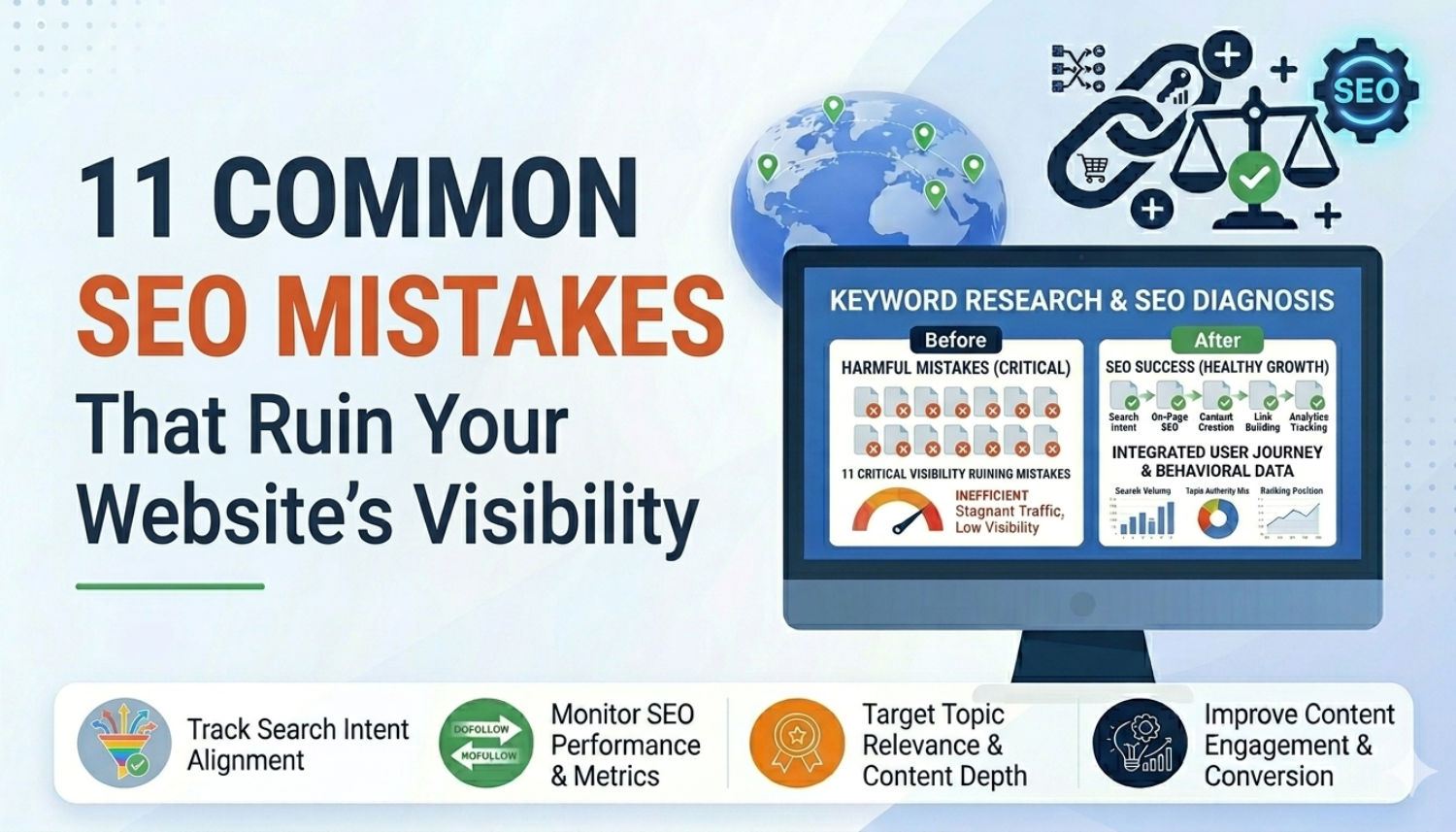
As a seasoned SEO content writer for Marastu, a digital marketing agency, I’ve seen countless websites struggle to rank for their top keywords. While the quality of content and number of backlinks are crucial factors in search engine optimization (SEO), they’re not the only culprits behind ranking issues. In this article, we’ll dive into the 11 most common SEO mistakes that can hold your site back and provide actionable tips on how to fix them.
SEO mistakes are depressingly common, and the bad news is that your site won’t rank while they remain a problem. The good news is that they’re easy to fix, and with the right strategies, you can improve your website’s visibility and drive more traffic to your site. Let’s get started by addressing the first two keyword-related issues that I see beginner SEOs make: targeting the wrong keywords and cannibalizing them.
Keyword Research Mistakes
New or inexperienced SEOs often focus their keyword research on broad, competitive keywords because they have the highest search volumes. However, this approach can lead to more competition, making it challenging for a new site to outrank established domains. Instead, I recommend targeting long-tail keywords, which are phrases with three or more words that are much less competitive and will usually bring in better-quality traffic because they’re so specific.
Targeting the Wrong Keywords
- Focus on long-tail keywords that are less competitive and more specific, such as “Shopify web developer in San Diego” instead of “web developer” with an SEO difficulty of 65 and an average domain authority of 78.
- Use keyword research tools, such as or SEMrush, to identify relevant and high-potential keywords for your business.
- Conduct thorough competitor research to understand what keywords your competitors are targeting and how you can differentiate your content.
Cannibalizing Keywords
Keyword cannibalization occurs when you have multiple pages targeting the same keyword, confusing Google and resulting in both pages suffering. To avoid this, dedicate a keyword to each page, giving every page a purpose and ensuring no two pages rank for the same term.
- Conduct a site audit to identify duplicate content and keywords, and create separate pages for each keyword or topic.
- Use a content management system (CMS) or a tool like to help you identify and remove duplicate content.
- Regularly review and update your content to ensure it remains relevant and optimized for the target keywords.
Content Optimization
Creating great content isn’t enough to rank in Google; you need to make sure your pages’ content aligns with the search intent. Search intent is the reason a user searches for a query, which can be informational, commercial, or transactional. Understanding your query’s search intent is easy; just Google your keyword and see which types of pages are ranking.
Understanding Search Intent
- Google your keyword and analyze the types of pages ranking, such as listicles, forum results, or product pages.
- Conduct user research to understand the needs and pain points of your target audience and create content that addresses those specific needs.
- Use tools like or SEMrush to analyze your competitors’ content and identify gaps in the market that you can fill.
Content Quality
With the abundance of content on the web, you need to create exceptional, unique, trustworthy, and backed-by-experience content to rank at the top of Google. While you don’t have to be a literary genius, you can’t get away with writing 100 words on each topic. Informative and exceptional content should be at least 1500 words in most cases.
Improving E-E-A-T Signals
- Regularly update your content to stay on top of the latest trends and ensure your content remains fresh in Google’s eyes.
- Use tools like or SEMrush to analyze your competitors’ content and identify gaps in the market that you can fill.
- Conduct user research to understand the needs and pain points of your target audience and create content that addresses those specific needs.
Conclusion
In conclusion, keyword research mistakes, such as targeting the wrong keywords and cannibalizing them, can hold your site back from ranking in Google. By understanding search intent, creating high-quality content, and improving E-E-A-T signals, you can improve your website’s visibility and drive more traffic to your site.
Remember, SEO is a continuous process that requires ongoing effort and improvement. By following the tips outlined in this article, you can fix common SEO mistakes and improve your website’s ranking and traffic.
Key Takeaways
- Target long-tail keywords that are less competitive and more specific.
- Dedicate a keyword to each page to avoid cannibalization.
- Understand search intent by analyzing the types of pages ranking for your keyword.
- Create high-quality, unique, trustworthy, and backed-by-experience content to rank at the top of Google.
- Regularly update your content to stay on top of the latest trends and ensure your content remains fresh in Google’s eyes.
Frequently Asked Questions (FAQs)
What is keyword cannibalization, and how can I avoid it?
Keyword cannibalization occurs when you have multiple pages targeting the same keyword, confusing Google and resulting in both pages suffering. To avoid this, dedicate a keyword to each page, giving every page a purpose and ensuring no two pages rank for the same term.
How do I improve my website’s E-E-A-T signals?
E-E-A-T signals refer to the four factors Google uses to rate your content: Experience, Expertise, Authoritativeness, and Trustworthiness. To improve your E-E-A-T signals, regularly update your content to stay on top of the latest trends and ensure your content remains fresh in Google’s eyes.
What is search intent, and how do I understand it?
Search intent is the reason a user searches for a query. To understand search intent, analyze the types of pages ranking for your keyword and conduct user research to understand the needs and pain points of your target audience.
How can I fix common SEO mistakes?
Fixing common SEO mistakes requires ongoing effort and improvement. By following the tips outlined in this article, you can improve your website’s ranking and traffic.